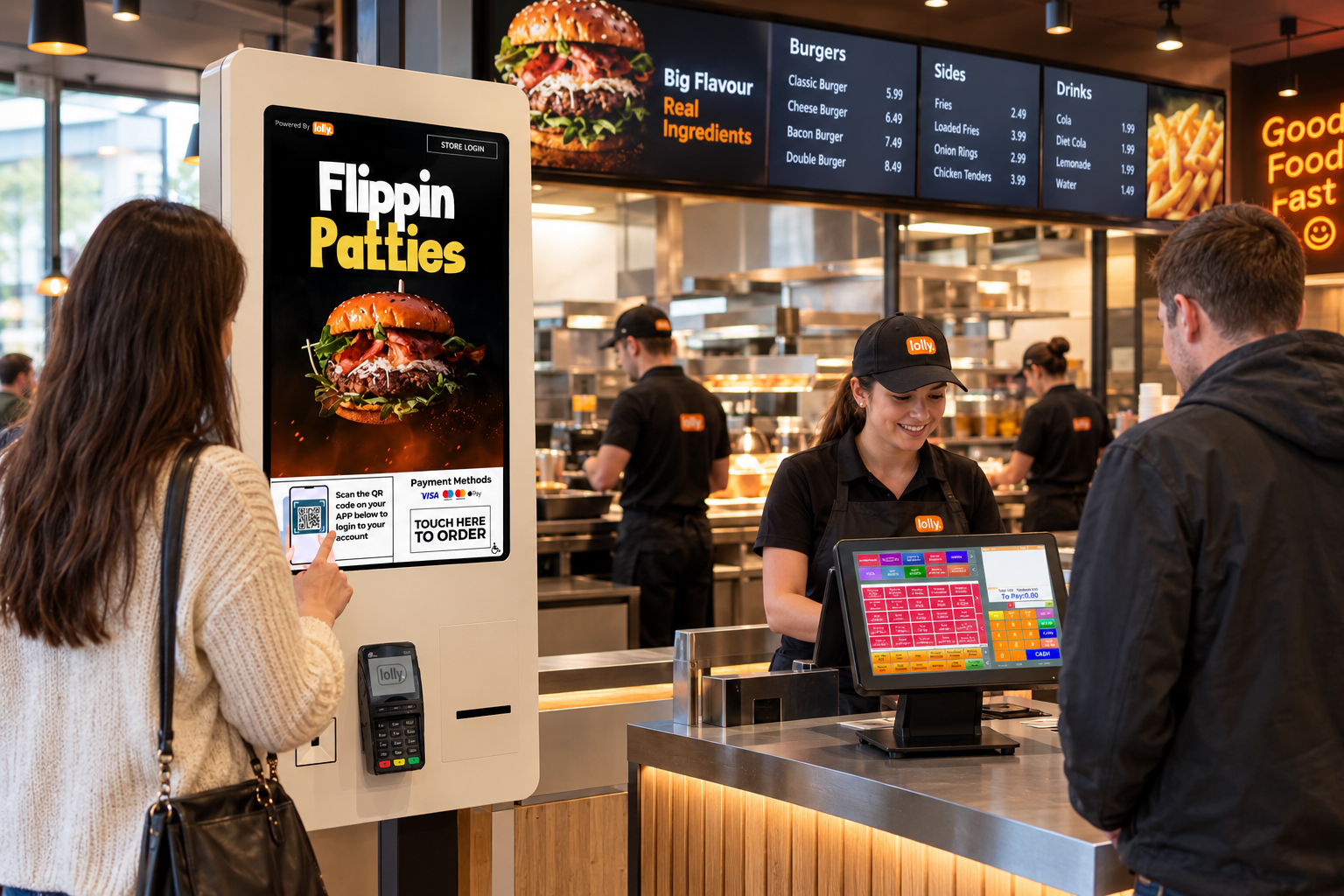
A busy city centre quick service restaurant at lunchtime presents a familiar picture. A queue builds at the staffed tills as customers wait to place orders, while nearby self-serve kiosks continue to process transactions at a steady pace. Staff are under pressure, customers are increasingly time conscious, and the operation must maintain both speed and accuracy.
At the same time, operators are balancing rising National Living Wage costs, increased National Insurance contributions and the ongoing complexity of recruitment, onboarding and retention. Too few staff creates service bottlenecks, while too many increases cost and reduces efficiency. Managing this balance has become a core operational challenge.
The question of kiosks versus staffed tills is simply a matter of operational design. What works best will vary depending on the venue, whether that is a high volume QSR, a stadium concourse or a full service restaurant. In many UK environments, the most effective solution is not either or, but a carefully integrated combination of both.
Throughput & Peak-Time Performance
Peak periods are where operational design is tested. Staffed tills are constrained by the number of trained employees available at any given time. Adding capacity requires additional labour, which is not always practical or cost effective.
Kiosks, by contrast:
Allow multiple customers to order simultaneously
Maintain consistent performance during busy periods
Reduce visible queues by distributing demand
This does not eliminate pressure on the kitchen, but it improves front of house flow and order intake.
Multi-Channel Order Convergence
Modern hospitality environments rarely rely on a single ordering channel. Instead, demand often converges from:
- Staffed tills
- Self-serve kiosks
- Delivery platforms such as Uber Eats, Deliveroo and Just Eat
- QR code ordering
- Staff handheld devices
- Bar or counter terminals
The challenge is not just throughput at the front end, but coordination across all channels.
An integrated platform allows all orders to flow into a single EPoS and kitchen management system, ensuring that demand is prioritised and managed consistently. Without this, efficiency gains at the kiosk level can be lost in kitchen bottlenecks or miscommunication.
The challenge is not just throughput at the front end, but coordination across all channels. An integrated platform allows all orders to flow into a single EPoS and kitchen system, ensuring that demand is prioritised and managed consistently. Without this, efficiency gains at the kiosk level can be lost in kitchen bottlenecks.
Upsell & Order Accuracy
Upselling is an area where human and digital approaches differ significantly.
Staffed tills rely on individual behaviour. Some team members consistently suggest upgrades or add ons, while others may forget or feel uncomfortable doing so, particularly during busy periods.
Kiosks provide:
- Structured prompts for add ons
- Visual menu reinforcement
- Consistent execution across every transaction
In addition, kiosks reduce order errors by allowing customers to review and confirm selections themselves. This can lower refund rates and improve overall satisfaction.
Customer Experience & Accessibility Considerations
Efficiency should not be considered in isolation from customer experience.
Not all customers prefer or feel comfortable using kiosks. Factors include:
- Digital literacy
- Accessibility needs
- Preference for human interaction
- Assisted ordering
- Handling complex requests
- Providing reassurance and hospitality
Well designed environments provide choice. Customers can select the channel that suits them best, improving both satisfaction and inclusivity.
The Case for a Hybrid Model
For many UK operators, the most effective approach is a hybrid model.
In this structure, kiosks handle the majority of routine, standard transactions, leaving staffed tills remain available for assisted service and exceptions. All channels feed into a unified EPoS and kitchen system, delivering several advantages:
- Reduced labour cost per transaction
- Flexibility to manage different customer needs
- Improved resilience during peak periods
- Greater visibility across all ordering channels
The key enabler is integration. Without a unified system, multiple channels can create complexity rather than efficiency.
There is no single answer to whether kiosks or staffed tills are more efficient. The reality depends on the trading environment, customer profile and operational priorities. Efficiency should be assessed using clear metrics such as cost per transaction, throughput and revenue impact.
For many UK hospitality businesses, a blended approach delivers the strongest results. Kiosks improve scalability and consistency, while staffed tills maintain flexibility and accessibility.
The role of technology is to support this balance, not dictate it. Lolly’s integrated platform enables operators to design their operation around their specific needs, ensuring that every channel contributes to overall efficiency, data accuracy and long term performance.